

Hey guys!
Welcome back to another shit blog. Today we’re tackling crypto challenge from daily AlpacaHack.
Description
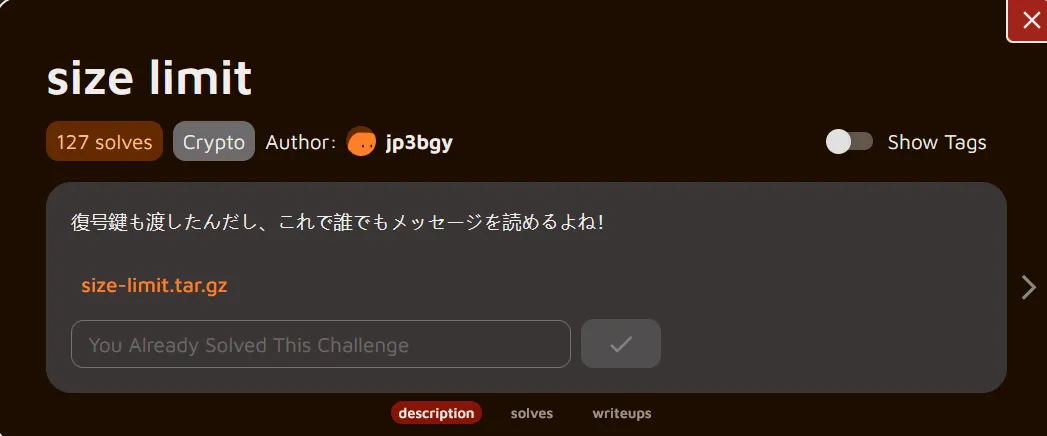
Translation
I gave you the decryption key too, so now anyone can read the message, right?Understanding the challenge
The challenge hints that even though RSA normally relies on keeping the private key secret, this time the private key d is given directly. We’re given the following problem.py
#!/usr/bin/python3
from Crypto.Util.number import getPrime, bytes_to_longimport flag
assert(len(flag.flag) == 131)
p = getPrime(512)q = getPrime(512)N = p * qphi = (p - 1) * (q - 1)e = 0x10001d = pow(e, -1, phi)
flag = bytes_to_long(flag.flag)
c = pow(flag, e, N)
print(f'N = {N}')print(f'e = {e}')print(f'c = {c}')print(f'd = {d}')
And the output for our encrypted flag:
N = 65667982563395257456152578363358687414628050739860770903063206052667362178166666380390723634587933595241827767873104710537142458025201334420236653463444534018710274020834864080096247524541536313609304410859158429347482458882414275205742819080566766561312731091051276328620677195262137013588957713118640118673e = 65537c = 58443816925218320329602359198394095572237417576497896076618137604965419783093911328796166409276903249508047338019341719597113848471431947372873538253571717690982768328452282012361099369599755904288363602972252305949989677897650696581947849811037791349546750246816657184156675665729104603485387966759433211643d = 14647215605104168233120807948419630020096019740227424951721591560155202409637919482865428659999792686501442518131270040719470657054982576354654918600616933355973824403026082055356501271036719280033851192012142309772828216012662939598631302504166489383155079998940570839539052860822636744356963005556392864865At first glance, this looks like a straightforward RSA decryption problem. But here’s the catch, The flag is 131 bytes long, while a 1024-bit RSA modulus is only 128 bytes. However, this means the message does not fit into the modulus.
So when the script encrypts the flag with:
c = pow(flag, e, N)it effectively computes:
c = flag mod NAnd when decrypting:
m = flag mod NSo the value we get from decryption (m) is not the actual flag, but only the flag reduced modulo N. To recover the full message, we must reconstruct the original flag using the partial information we have.
We know:
- the prefix of the flag (
TSGLIVE{), - the total length (131 bytes),
- and its value modulo N (
m).
This is enough to rebuild the entire flag.
Solution
Because RSA only gave us the flag modulo N, the real flag must be:
flag = k × N + m for some integer k.So what do we do? We search for the smallest k that makes the reconstructed message start with our known prefix. Once that happens, we know we’ve aligned the flag correctly.
Here’s the solver:
from Crypto.Util.number import *
N = 65667982563395257456152578363358687414628050739860770903063206052667362178166666380390723634587933595241827767873104710537142458025201334420236653463444534018710274020834864080096247524541536313609304410859158429347482458882414275205742819080566766561312731091051276328620677195262137013588957713118640118673e = 65537c = 58443816925218320329602359198394095572237417576497896076618137604965419783093911328796166409276903249508047338019341719597113848471431947372873538253571717690982768328452282012361099369599755904288363602972252305949989677897650696581947849811037791349546750246816657184156675665729104603485387966759433211643d = 14647215605104168233120807948419630020096019740227424951721591560155202409637919482865428659999792686501442518131270040719470657054982576354654918600616933355973824403026082055356501271036719280033851192012142309772828216012662939598631302504166489383155079998940570839539052860822636744356963005556392864865
flag_prefix = b"TSGLIVE{"flag_len = 131m = pow(c, d, N)flag_tmp = bytes_to_long(flag_prefix + b"\x00" * (flag_len - len(flag_prefix)))flag = ((flag_tmp - m) // N + 1) * N + mprint(f"Flag : {long_to_bytes(flag).decode()}")
How it works:
- Decrypt normally:
m = pow(c, d, N)gives usflag mod N - Build a template: Create
flag_tmpusing the known prefix padded with null bytes to match the expected 131-byte length - Calculate k: The formula
((flag_tmp - m) // N + 1)determines how many complete cycles ofNwe need to add back - Reconstruct:
flag = k × N + mgives us the original message
The key insight is that since we know the flag format and length, we can estimate where the actual flag value should be numerically, then work backwards to find the correct multiple of N to add.
Fire it up and we got the looonggg flagg:
┌──(chjwoo㉿hackbox)-[~/…/alpacahack/cry/size-limit/size-limit]└─$ python solver.pyFlag : TSGLIVE{Tttthhhhhiiiiiiisssss iiiiiiiiiisssss aaaaaaaaaaaaaa tooooooooooooooooooooo looooooooooooooooong fllllaaaaaaaaaaaaaaaaaag!}Flag
TSGLIVE{Tttthhhhhiiiiiiisssss iiiiiiiiiisssss aaaaaaaaaaaaaa tooooooooooooooooooooo looooooooooooooooong fllllaaaaaaaaaaaaaaaaaag!}